Education

Why Nicotine and Vaping Can Delay Your Plastic Surgery
Patients are sometimes surprised when I tell them that nicotine can be a reason to postpone elective plastic surgery.
They may say, “But I don’t smoke cigarettes—I only vape.”
From a surgical standpoint, that distinction may not solve the problem.
Nicotine itself can negatively affect circulation and wound healing. That matters tremendously in plastic surgery because healthy blood flow is essential to keeping skin and tissue alive while the body heals.
Why Does Nicotine Matter So Much?
Many plastic surgery procedures involve lifting, tightening, repositioning or removing tissue.
The remaining tissue must maintain an adequate blood supply while it heals.
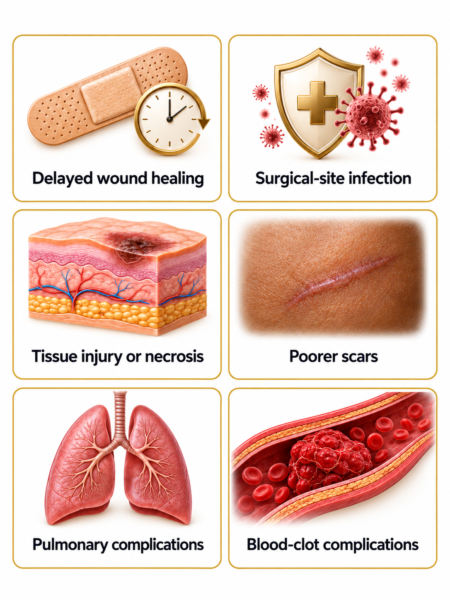
Nicotine can compromise that process and is associated with increased risks including
- Delayed wound healing
- Surgical-site infection
- Tissue injury or necrosis
- Poorer scars
- Pulmonary complications
- Blood-clot complications
That is why this is a safety issue—not a lifestyle judgment. |
|
Vaping Still Counts
A very common misconception is that vaping is acceptable because there is no traditional cigarette smoke.
If the product contains nicotine, your surgical team needs to know about it.
The same conversation applies to other nicotine-containing products, which may include patches, gum, pouches and some smoking alternatives.
Do not switch from cigarettes to another nicotine source and assume you have solved the surgical concern.
Why Is This Especially Important in Plastic Surgery?
Consider procedures such as a tummy tuck, breast lift or breast reduction.
During surgery, tissue is reshaped and repositioned. The skin and deeper tissues rely on healthy circulation during healing.
Anything that significantly compromises blood flow can threaten both healing and the cosmetic result.
This is one reason an experienced surgeon may postpone an operation rather than take a preventable risk.
Be Completely Honest With Your Surgical Team
Never hide nicotine use because you’re concerned your surgery might be delayed.
A temporary delay is far easier to deal with than a preventable wound complication.
Tell your team about:
- Cigarettes
- Vaping
- Hookah
- Cigars
- Nicotine gum
- Nicotine patches
- Other nicotine products
Your surgeon can then tell you how long you need to stop before and after your particular procedure.
The Bottom Line
One of the most important lessons I’ve learned from thousands of surgical transformations is that beautiful results depend on healthy healing.
There are certain risks your surgeon controls through technique, planning and safety protocols.
There are others that require partnership from the patient.
Nicotine avoidance is one of them.
If we ask you to stop nicotine, we’re not making surgery harder to qualify for. We’re trying to make surgery safer to recover from.
BOOK YOUR CONSULTATION
Education
Can You Safely Combine Multiple Plastic Surgery Procedures?
“Can I just do everything at once?”
I hear this question frequently—especially from patients considering a tummy tuck, breast surgery, liposuction or a Mommy Makeover.
The answer is:
Sometimes. But convenience should never outrank safety.
Why Combine Procedures?
For an appropriately selected patient, combining procedures can make sense.
Potential advantages include:
- One anesthesia event instead of multiple separate surgeries
- One overall recovery period
- Better coordination of body proportions
- Potential efficiencies in facility and anesthesia costs
This is why combinations such as breast surgery with abdominal contouring are popular.
Why Not Combine Everything?
Every procedure adds something:
- More operative time
- More surgical stress
- More areas that need to heal
- More complex recovery restrictions
At some point, combining additional procedures stops being an advantage.
There is no single universal number of procedures that is safe for every patient. The decision depends on the total operation, expected length of surgery and your individual risk profile.
What Does Your Surgeon Evaluate?
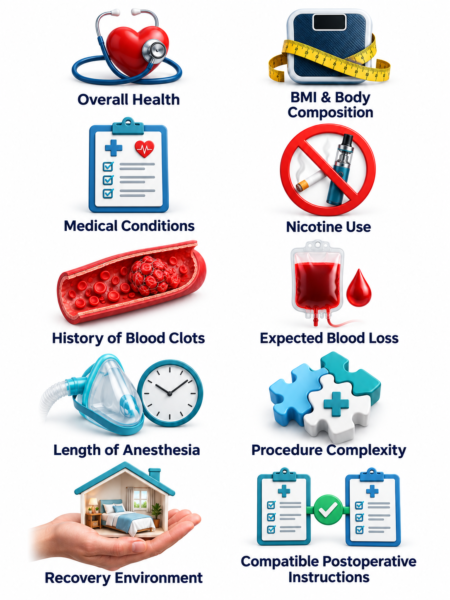
Before recommending combination surgery, we consider factors such as:
- Your overall health
- BMI and body composition
- Medical conditions
- Nicotine use
- History of blood clots
- Expected blood loss
- Length of anesthesia
- Complexity of each procedure
- Your recovery environment
- Whether the postoperative instructions for each operation are compatible
|
|
Sometimes Staging Produces the Better Plan
Staging means separating your transformation into two or more surgeries.
Patients sometimes hear this as bad news.
It isn’t.
There are times when staging allows us to:
- Reduce the burden of one operation
- Allow one area to heal before addressing another
- Evaluate the first result before planning the second
- Create a more manageable recovery
An experienced surgeon should be comfortable telling you that the safer answer is not necessarily the fastest one.
What About a Mommy Makeover?
“Mommy Makeover” is not one fixed operation.
It may describe different combinations of breast and body procedures based on what a patient actually needs.
That is why two patients asking for a Mommy Makeover may receive very different surgical plans.
Your anatomy—not the package name—should determine your treatment.
The Right Question to Ask
Instead of asking:
“How many procedures can I fit into one surgery?”
Ask:
“What combination gives me the best balance between meaningful results and acceptable risk?”
That is the conversation that matters.
After thousands of transformations, I have learned that restraint is sometimes just as important as surgical skill.
Doing more is not automatically better.
Doing what is appropriate for the patient is better.
Link text
Education
Is Your BMI Too High for Plastic Surgery? What Actually Matters
One of the most common questions I hear from patients is, “Is my BMI too high for plastic surgery?”
It’s an important question, but BMI does not tell the entire story.
Body Mass Index is simply a calculation based on your height and weight. It can help us screen for potential surgical risk, but it does not directly measure body fat, tell us where your fat is located, or replace a proper medical evaluation.
Why Does BMI Matter Before Plastic Surgery?
Plastic surgery is elective, which means we have an opportunity to identify and reduce avoidable risks before surgery.
A higher BMI may occur alongside other factors that can influence surgery and recovery, including high blood pressure, diabetes, sleep apnea, limited mobility and increased risk for certain postoperative complications.
That is why responsible plastic surgeons consider BMI as part of the overall safety assessment.
But BMI Is Not the Same as Health
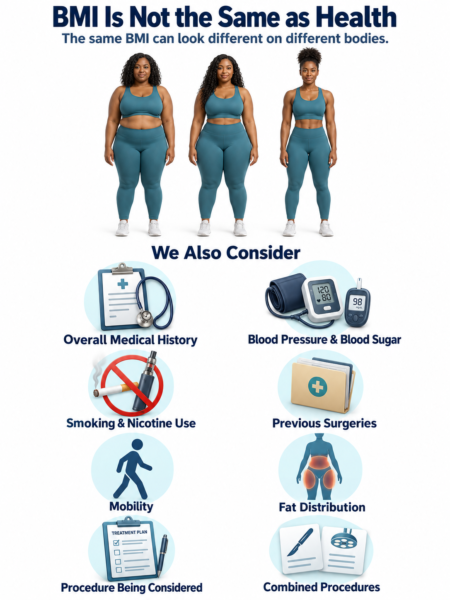
Two patients can have exactly the same BMI and have very different bodies.
One may carry most of their weight around the abdomen. Another may carry more weight through the hips and thighs. Another may have significantly more muscle mass.
We also consider:
- Overall medical history
- Blood pressure and blood sugar control
- Smoking or nicotine use
- Previous surgeries
- Mobility
- Fat distribution
- The procedure being considered
- Whether several procedures are being combined
This is why a BMI calculator should never be used by itself to decide whether someone is safe for surgery. |
|
What Is Dr. Curves’ BMI Guideline?
At our practice, our usual target for surgical consideration is a BMI of 31.9 or below.
That guideline exists for safety.
However, if someone is only slightly above that range, there may be circumstances where Dr. Curves wants to evaluate the patient more closely before making a final determination.
Where the weight is located, the patient’s medical health, body composition and the planned operation can all matter.
Being slightly above 31.9 does not guarantee approval for surgery. It simply means that an individualized conversation may sometimes be appropriate.
What If My BMI Needs to Come Down?
Do not crash diet just to reach a number.
If surgery is your goal, we want you entering the operating room not only lighter, but also adequately nourished, hydrated and medically prepared to heal.
A sustainable plan may include:
- Higher-protein, nutrient-dense meals
- Reasonable portion control
- Reducing liquid calories and highly processed foods
- Regular walking and cardiovascular activity
- Strength training when appropriate
- Improving sleep
- Medical weight-management treatment for appropriate patients
For some patients, medications such as semaglutide may be an option after medical evaluation. Medication should support healthy habits rather than replace them.
Read our Weight Loss Guide for a deeper look at lowering BMI through nutrition, lifestyle and medically supervised options.
The Number Starts the Conversation
After more than two decades evaluating plastic surgery patients, I can tell you that numbers are useful—but patients are not numbers.
We evaluate the whole person.
If you’re unsure whether your current BMI makes you a candidate, the safest approach is to have your individual situation evaluated instead of trying to make that decision from an online calculator.
Your goal should not simply be reaching a number. Your goal should be becoming the safest, strongest surgical candidate possible.
Link text