Why Results Can Look Worse Before Better

Why Plastic Surgery Results Can Look Worse Before They Look Better
One of the hardest parts of plastic surgery recovery is something many patients are not prepared for:
Your body may not look the way you expected immediately after surgery.
You may be swollen.
One side may look different from the other.
Your breasts may sit higher than expected.
Your abdomen may feel extremely tight.
Your liposuction result may temporarily look puffy instead of smaller.
This is one reason I tell patients not to judge a surgical result during the earliest stages of healing.
Surgery Creates Controlled Trauma
Plastic surgery reshapes living tissue.
Your body responds by initiating the normal healing process, which includes inflammation and swelling.
Early swelling can temporarily:
- Hide definition
- Make areas look larger
- Create unevenness
- Make clothing fit strangely
- Distort the final contour
That does not mean your result will remain that way.
Healing Does Not Happen Symmetrically
Your left and right sides are not identical before surgery—and they do not necessarily heal at exactly the same speed afterward.
Temporary differences may occur because of:
- Uneven swelling
- Different amounts of work performed on each side
- Sleeping position
- Normal pre-existing asymmetry
- Individual tissue response
This is particularly important after breast surgery and body contouring.
Your Result Has Several Stages
Think of recovery as a progression rather than a reveal.
Early stage: swelling, bruising, tightness and unfamiliar contours.
Intermediate stage: swelling decreases and tissues begin settling.
Later stage: scars mature, tissues soften and the contour becomes more representative of the final result.
Some body-contouring results continue refining for many months. ASPS notes that after major-weight-loss body contouring, final results may take much longer to fully mature.
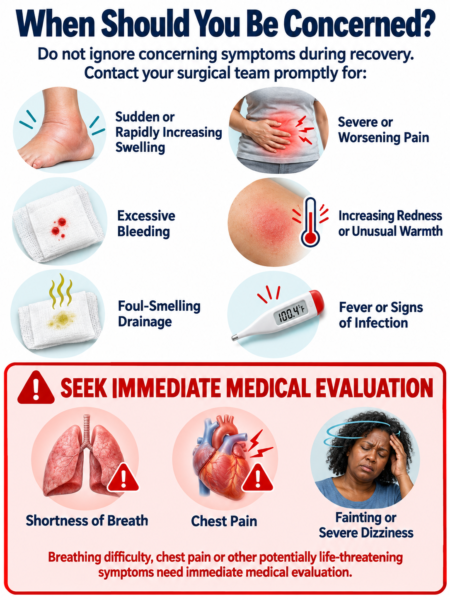
When Should You Be Concerned?Normal recovery should never be used as an excuse to ignore concerning symptoms. Contact your surgical team promptly if you experience symptoms such as:
Breathing difficulty, chest pain or other potentially life-threatening symptoms require immediate medical evaluation. |
 |
Don’t Compare Your Week Two to Someone Else’s Month Six
Social media has distorted recovery expectations.
A polished before-and-after photograph rarely shows the swollen Tuesday morning, the compression garment, the bruising, or the weeks spent waiting for tissues to settle.
After more than 20 years watching patients heal, one of the most important pieces of advice I can give is:
Don’t judge a healing body like it is a finished result.
Follow your instructions, attend your postoperative appointments and give your body the time it needs.
Patience Is Part of the Procedure
Your surgeon performs the operation in hours.
Your body performs the healing over weeks and months.
Both are part of your transformation.
Link text